
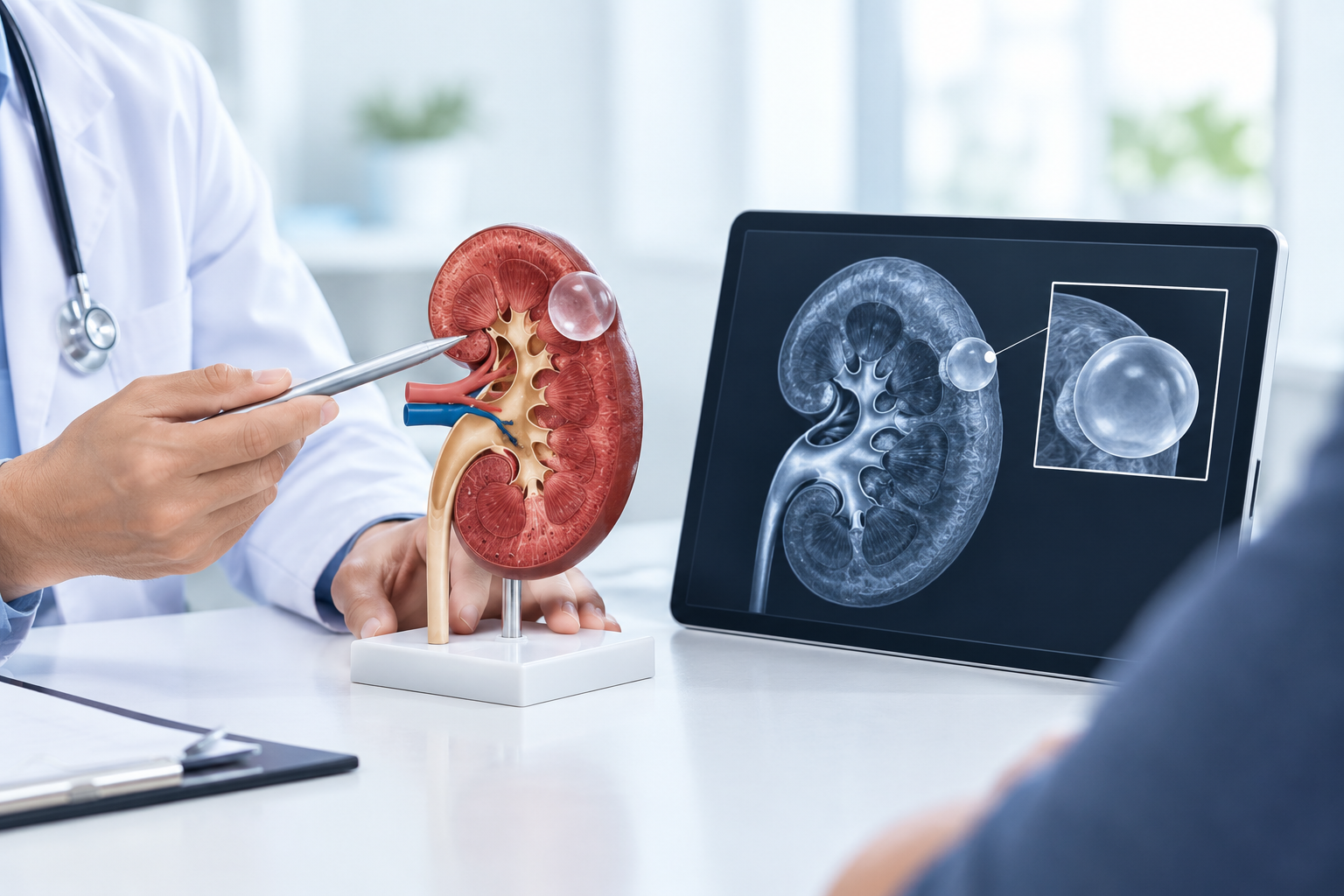
Finding the words kidney cyst in an ultrasound or CT scan report can be worrying, especially when you do not know whether the finding is serious. The reassuring fact is that simple kidney cysts are common and usually harmless. Many do not cause symptoms, affect kidney function or require treatment. However, not every cyst has the same appearance or significance. Some findings need additional imaging, monitoring or specialist evaluation to understand what they are. Knowing the difference between a simple kidney cyst and a cyst with more complex features can help you understand what to discuss with your doctor and why the details in your scan report matter.
What Are Kidney Cysts?
Kidney cysts are fluid-filled sacs that develop in or on the kidneys. They may occur in one kidney or both, and a person may have a single cyst or several cysts.
The term renal cyst is another name for a kidney cyst. These cysts vary in size and appearance, and their significance depends on their characteristics, the number of cysts and whether they are associated with symptoms or an underlying condition.
Simple kidney cysts are generally round or oval, contain fluid and have a thin, smooth wall. They are often discovered incidentally when an ultrasound, CT scan or MRI is performed for another reason.
A cyst is not automatically a sign of kidney cancer. However, a cyst with unusual imaging features may require additional assessment to distinguish a benign finding from a lesion that needs closer investigation.
What Causes Kidney Cysts?
The exact cause of simple kidney cysts is not fully understood. They become more common with increasing age, and many people have them without experiencing any symptoms.
A simple kidney cyst is different from the inherited or acquired conditions that can cause numerous cysts to develop throughout the kidneys. The number of cysts, family history, kidney function and imaging appearance help doctors determine whether a finding is isolated or part of a broader condition.
Possible explanations and associated conditions include:
- Simple kidney cysts that develop with age and have no clearly established cause
- Multiple kidney cysts associated with inherited conditions such as autosomal dominant polycystic kidney disease
- Acquired cystic kidney disease in certain people with long-standing kidney disease, particularly those receiving dialysis
- Other cystic kidney conditions that require assessment based on family history, imaging and kidney function
What Are the Symptoms of Kidney Cysts?
Most simple kidney cysts do not cause symptoms. People often discover them during an imaging test performed for abdominal discomfort, a urinary problem or another unrelated reason.
When a cyst becomes large or develops a complication, symptoms may occur. These can include:
- Dull pain in the back or side
- Discomfort in the upper abdomen
- Pain or tenderness if a cyst becomes infected
- Blood in the urine if bleeding occurs
- Fever when an infection is present
- High blood pressure in some cases
- Problems with urine drainage if a cyst presses on the urinary tract
Are Simple and Complex Kidney Cysts Different?
Yes. The distinction is important because the appearance of a cyst on imaging helps determine whether observation is sufficient or additional tests are needed.
A simple kidney cyst usually has a thin, smooth wall and fluid-filled contents without concerning internal features. When it has been confidently identified as simple and is not causing symptoms, treatment is generally unnecessary.
A complex kidney cyst may have features such as internal partitions, a thickened or irregular wall, calcification or solid components. These findings do not automatically mean cancer, but they can require more detailed assessment.
Doctors may use contrast-enhanced CT or MRI to characterise a cyst when the initial ultrasound does not provide enough information. Depending on the imaging findings, a specialist may recommend monitoring, further investigation or treatment.
The word complex in a scan report should therefore be interpreted in context. The specific imaging characteristics matter more than the label alone.
Is a Kidney Cyst Dangerous?
Most simple kidney cysts are not dangerous. They usually do not interfere with normal kidney function and do not need treatment if they have been confidently characterised as simple and are not causing problems.
The situation is different when a cyst has concerning imaging features, becomes infected, bleeds, grows large enough to cause pressure or obstructs urine flow. Such findings may require further testing or treatment.
People with multiple cysts, a family history of polycystic kidney disease or evidence of impaired kidney function may need a broader evaluation rather than being treated as having an isolated simple cyst.
If your scan report mentions a complex cyst, a suspicious renal lesion or a recommendation for follow-up imaging, discuss the findings with your doctor instead of assuming the cyst is either harmless or cancerous.
Can Kidney Cysts Cause Pain?
A small simple kidney cyst often causes no pain. A larger cyst may occasionally produce a dull ache in the side, back or upper abdomen by putting pressure on nearby structures.
Pain can also occur if a cyst becomes infected, bleeds or ruptures. However, back pain is common and frequently comes from muscles, the spine, kidney stones or other causes.
If you have a kidney cyst and persistent pain, a clinician needs to assess whether the cyst is actually responsible. Treating an incidental cyst will not necessarily improve pain caused by another condition.
How Are Kidney Cysts Diagnosed?
Kidney cysts are usually evaluated through imaging. The appropriate test depends on how the cyst was discovered, its appearance, your symptoms and whether there are concerns about kidney function.
Investigations may include:
- Ultrasound to identify a cyst and assess its basic appearance
- CT scan to examine the cyst in greater detail when indicated
- MRI when further characterisation is needed
- Urine testing if blood or infection is suspected
- Blood tests to assess kidney function when clinically appropriate
- Review of previous scans to determine whether the appearance has changed
Does the Size of a Kidney Cyst Matter?
Size is one factor doctors consider, but it does not tell the whole story. A relatively large simple cyst may remain harmless, while a smaller cyst with concerning internal features may require closer assessment.
Doctors consider the cyst's appearance, location, growth over time, symptoms and effect on nearby structures. A cyst that blocks urine drainage or causes persistent pain may need treatment even if it is benign.
There is no single size threshold that determines treatment for every kidney cyst. Decisions should be based on the complete imaging findings and clinical situation rather than size alone.
Do Kidney Cysts Need Treatment?
Most simple kidney cysts do not need treatment if they cause no symptoms and have a reassuring appearance. Depending on the circumstances, a doctor may recommend no further testing or periodic imaging to monitor the finding.
Treatment may be considered when a cyst causes persistent symptoms, becomes infected, bleeds, affects urine drainage or has imaging features that require intervention.
The purpose of treatment is to address the specific problem. A cyst should not be treated solely because it appears in a report if it is harmless and does not require intervention.
What Are the Treatment Options for Kidney Cysts?
The treatment approach depends on the cyst's characteristics and the problem it is causing. Options may include observation, a minimally invasive drainage procedure or surgery in selected cases.
Possible approaches include:
- Observation for simple cysts that are not causing symptoms or other problems
- Follow-up imaging when monitoring is appropriate
- Image-guided drainage with a sclerotherapy procedure for selected symptomatic cysts
- Laparoscopic surgery to treat certain large or persistently symptomatic cysts
- Additional specialist assessment or treatment for complex cysts, depending on their risk classification
- Treatment of an associated infection or another complication when present
Can Kidney Cysts Turn Into Cancer?
A typical simple kidney cyst is benign and is not treated as kidney cancer. The important distinction is between a confidently identified simple cyst and a cystic lesion with features that need further evaluation.
Complex cystic lesions may require a more detailed assessment because some can contain cancerous tissue. Imaging classification, including the features seen on contrast-enhanced CT or MRI, helps guide the next step.
If your report describes a complex renal cyst or an indeterminate lesion, ask your doctor what the imaging findings mean and whether further imaging, surveillance or specialist review is recommended.
What Is the Difference Between Kidney Cysts and Polycystic Kidney Disease?
An isolated simple kidney cyst is not the same as polycystic kidney disease. Simple cysts are common, particularly as people get older, and often have no meaningful effect on kidney function.
Polycystic kidney disease is a condition in which multiple cysts develop in the kidneys and can progressively affect their structure and function. It may be inherited and can be associated with high blood pressure, kidney enlargement and other complications.
A person with several cysts does not automatically have polycystic kidney disease. The number and distribution of cysts, age, family history, kidney function and other clinical findings help determine whether further assessment is needed.
When Should You See a Urologist for Kidney Cysts?
You should discuss a kidney cyst with a doctor if the report describes complex or indeterminate features, if you have persistent side or back pain, or if the cyst is suspected of affecting urine drainage.
A urology evaluation may also be appropriate if there is blood in the urine, recurrent symptoms, a cyst that has changed on follow-up imaging or uncertainty about whether a procedure is needed.
Seek urgent medical assessment if you develop severe or sudden flank pain, fever with pain, visible blood in the urine with significant symptoms or difficulty passing urine. These symptoms may have causes other than a cyst and should not be ignored.
The Takeaway
Kidney cysts are fluid-filled sacs that are often discovered by chance during imaging. Most simple kidney cysts are harmless and do not require treatment.
Complex imaging features, persistent pain, infection, bleeding or obstruction may require further evaluation. The cyst's appearance and clinical context matter more than size alone.
If an ultrasound or CT report mentions a kidney cyst, have the findings interpreted in context. The right next step may be reassurance, monitoring, additional imaging or treatment, depending on what the cyst actually looks like and whether it is causing problems.
Resources
- Simple Kidney CystsNational Institute of Diabetes and Digestive and Kidney Diseases
- Kidney Cysts: Symptoms and CausesMayo Clinic
 FAQs
Frequently asked questions
Kidney cysts are fluid-filled sacs that develop in or on the kidneys. Simple kidney cysts are common and usually harmless, while cysts with complex imaging features may require further assessment.