
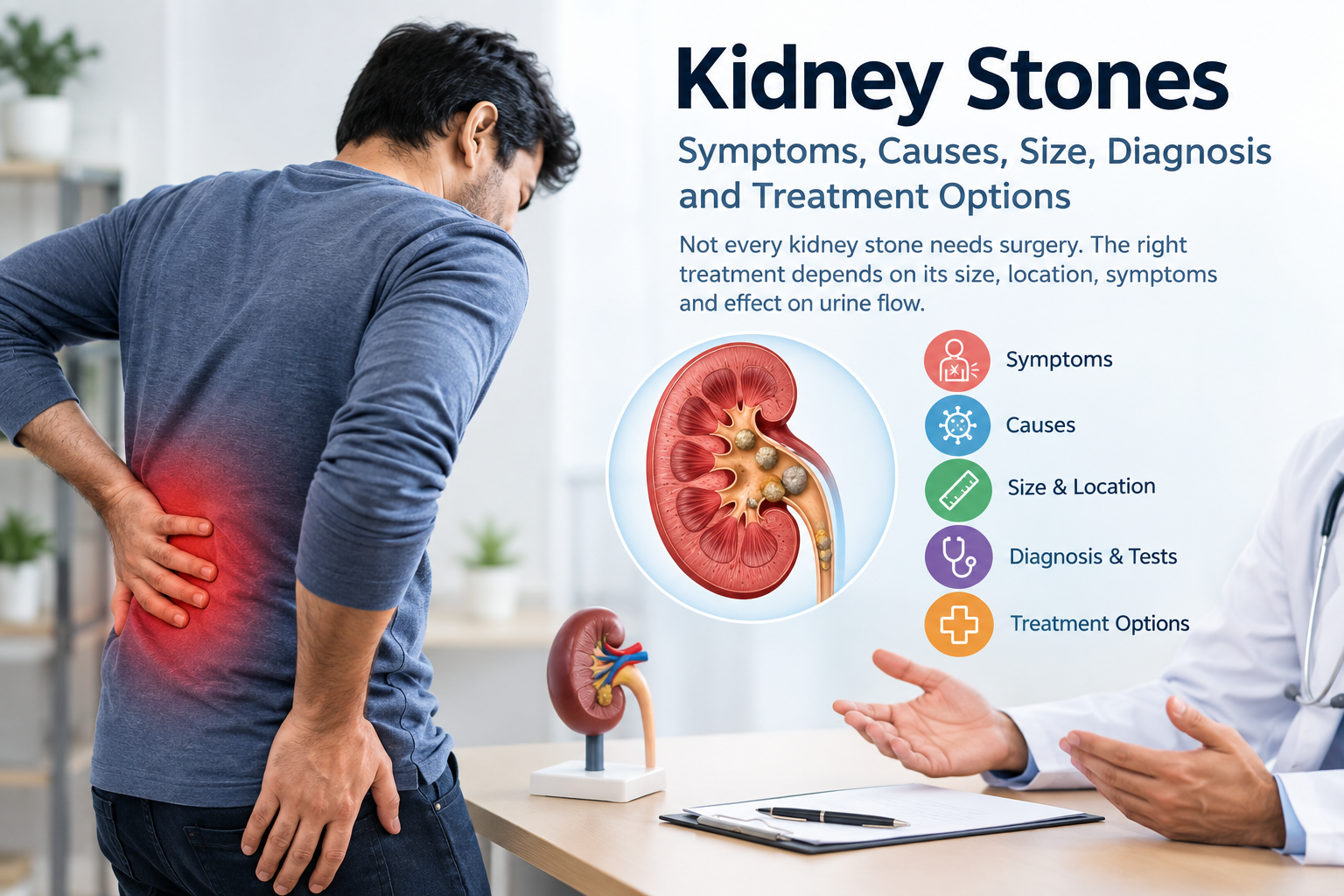
Kidney stones are hard deposits that form when certain minerals and salts become concentrated in the urine. A small stone may pass without causing major symptoms, while a stone that moves into the ureter can cause severe pain, blood in the urine and difficulty passing urine. The treatment is not the same for every stone: size, location, symptoms, blockage and the type of stone all matter.
What Are Kidney Stones?
Kidney stones are solid, pebble-like deposits that form inside the kidneys from substances normally present in urine. Common types include calcium stones, uric acid stones, struvite stones and cystine stones. A stone may remain in the kidney without causing symptoms, but problems can develop when it moves into the ureter and obstructs the flow of urine.
Common Symptoms of Kidney Stones
- Sharp or severe pain in the side or back
- Pain that may move toward the lower abdomen or groin
- Pain that comes and goes in waves
- Blood in the urine, which may appear pink, red or brown
- Burning or pain while urinating
- Frequent or urgent need to urinate
- Passing only a small amount of urine
- Cloudy or bad-smelling urine
- Nausea or vomiting
- Fever or chills, particularly when an infection is also present
Where Does Kidney Stone Pain Usually Occur?
Kidney stone pain commonly starts in the back or side below the ribs and can move toward the lower abdomen or groin as the stone travels down the ureter. The location and intensity of pain can change as the stone moves. Pain may also come in waves rather than remaining constant.
Severe pain with fever, chills, vomiting, inability to pass urine or significant bleeding should not be managed at home without medical evaluation.
Why Do Kidney Stones Form?
- Not drinking enough fluid, leading to concentrated urine
- High levels of calcium, oxalate or uric acid in the urine
- High dietary sodium intake
- Certain dietary patterns or high animal-protein intake
- Family history of kidney stones
- Previous history of kidney stones
- Certain metabolic conditions, including hyperparathyroidism
- Urinary tract infections, particularly with certain types of stones
- Some medicines and medical conditions that alter urine chemistry
Does Kidney Stone Size Matter?
Yes. Stone size is one of the factors a urologist considers when deciding whether a stone is likely to pass on its own or whether active treatment may be needed. Smaller stones are more likely to pass spontaneously, while larger stones are more likely to become stuck or require a procedure. Size alone, however, does not determine treatment. The stone's location, symptoms, blockage and the patient's overall condition are also important.
A 5 mm stone and a 10 mm stone should not automatically be treated in the same way. Your imaging report and clinical findings are needed to decide the appropriate approach.
Can a Kidney Stone Pass Without Surgery?
Some small kidney stones can pass through the urinary tract without a procedure. A urologist may recommend observation, appropriate fluid intake and pain management when spontaneous passage is considered reasonable. Medication may sometimes be used to help a stone pass, depending on its location and the individual situation.
Do not force excessive water intake during severe pain or vomiting. A blocked urinary tract may require urgent treatment rather than simply drinking more water.
How Are Kidney Stones Diagnosed?
- Medical history and physical examination
- Urinalysis to look for blood, minerals and signs of infection
- Blood tests to evaluate kidney function and mineral levels when appropriate
- Ultrasound to identify stones and urinary tract obstruction
- X-ray in selected cases, depending on the type of stone
- CT scan when detailed information about stone size, location or obstruction is required
- Stone analysis when a passed or removed stone is available
- 24-hour urine testing in selected patients with recurrent or high-risk stones
What Is the Treatment for Kidney Stones?
Treatment depends on the stone's size, location, symptoms and whether it is blocking urine flow. Observation may be appropriate for some small stones. Larger stones, persistent obstruction, significant pain, infection or stones that are unlikely to pass may require a procedure.
Common procedures include shock wave lithotripsy (ESWL), ureteroscopy with stone fragmentation or removal, and percutaneous nephrolithotomy for larger or complex stones.
Common Kidney Stone Removal Procedures
- Shock Wave Lithotripsy (ESWL): Shock waves are used to break a stone into smaller fragments that can pass through the urinary tract.
- Ureteroscopy and Laser Lithotripsy: A thin scope is passed through the urinary tract to reach the stone, which can then be fragmented with a laser and removed or allowed to pass as small pieces.
- Percutaneous Nephrolithotomy (PCNL): A small access tract is created through the back to remove larger or complex kidney stones.
- Ureteral Stent: A temporary stent may sometimes be placed to help urine flow or support drainage before or after stone treatment.
When Does a Kidney Stone Become an Emergency?
A kidney stone can become urgent when it blocks urine flow, causes severe uncontrolled pain, or is associated with infection. An infected and obstructed urinary tract can require urgent drainage and treatment.
Seek prompt medical attention for severe or worsening pain, fever or chills, repeated vomiting or dehydration, inability to urinate, significant blood in the urine, or symptoms suggesting an infection.
What Should You Eat If You Have Kidney Stones?
- Maintain adequate fluid intake unless a doctor has advised you to restrict fluids.
- Reduce excessive salt intake.
- Do not automatically eliminate dietary calcium; the appropriate amount depends on your stone type and overall health.
- Avoid making major dietary restrictions without knowing the type of stone you have.
- Depending on the stone type, a doctor may recommend changes to oxalate, animal protein, sodium or other dietary factors.
- People with recurrent stones may benefit from a metabolic evaluation and personalised dietary advice.
Can Kidney Stones Damage the Kidneys?
A kidney stone that passes without causing prolonged obstruction usually does not cause permanent kidney damage. However, a stone that remains stuck and blocks urine flow can cause complications, particularly when infection is present. Recurrent stones can also indicate an underlying metabolic or dietary problem that should be evaluated.
When Should You See a Urologist for a Kidney Stone?
You should consider a urology evaluation if imaging has identified a kidney stone, pain is recurring, the stone is not passing, there is urinary obstruction, you have repeated kidney stones, or you have symptoms of infection. A urologist can assess the stone's size and location and explain whether observation, medication or a procedure is appropriate.
Have a Kidney Stone?
If you have been diagnosed with a kidney stone or are experiencing recurrent stone pain, a urological evaluation can help determine whether the stone is likely to pass naturally or needs active treatment.
Resources
 FAQs
Frequently asked questions
Common symptoms include sharp pain in the back or side, pain that may move toward the lower abdomen or groin, blood in the urine, painful urination, nausea and an urgent need to urinate. Small stones may sometimes cause no symptoms.