
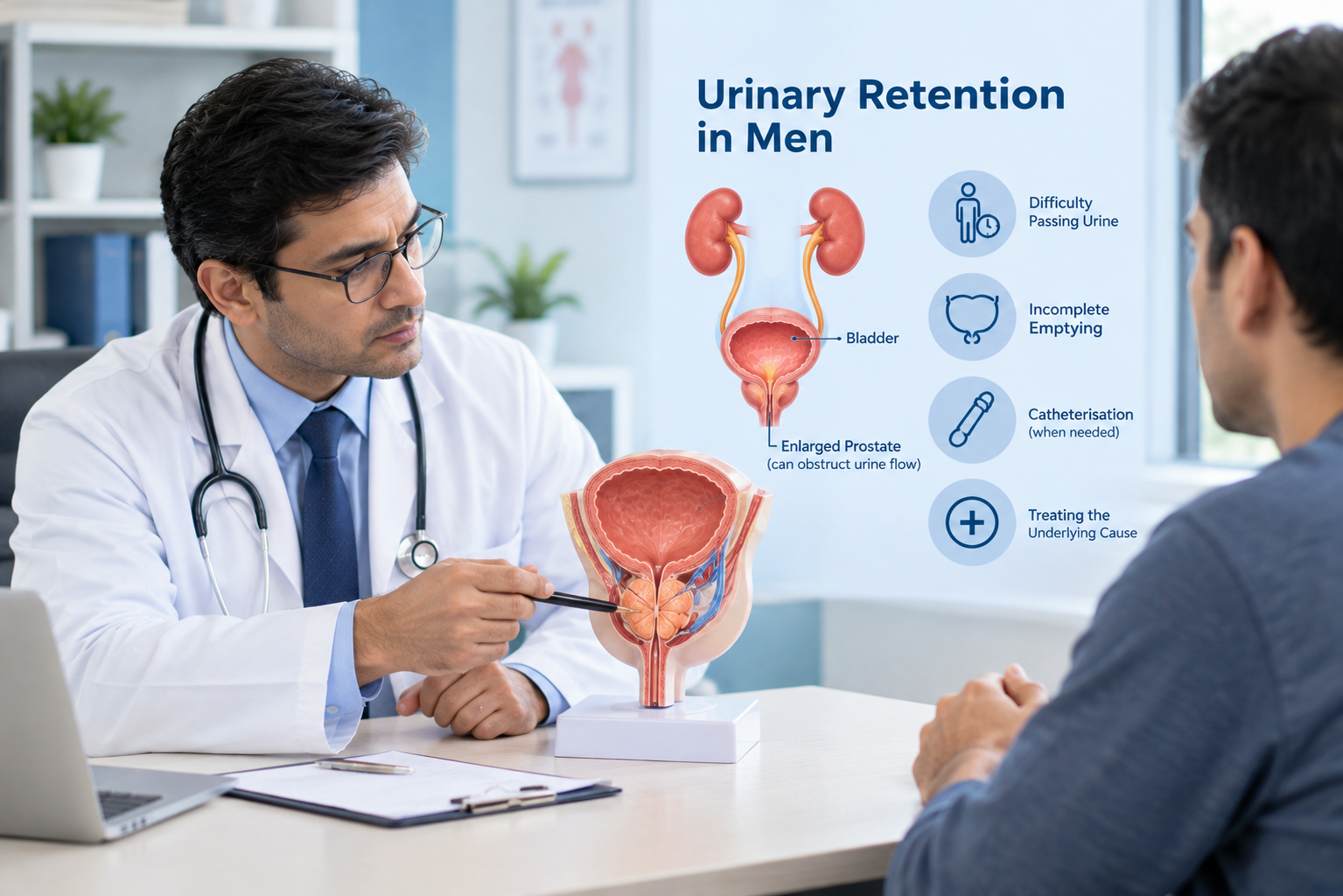
Urinary retention is a condition in which a person cannot empty the bladder completely or cannot pass urine at all. In men, a common cause is an enlarged prostate that obstructs the flow of urine, but medications, urethral narrowing, nerve problems and other conditions can also contribute. Symptoms may develop gradually or appear suddenly. Sudden inability to urinate is a medical emergency that requires immediate assessment, while persistent difficulty emptying the bladder also deserves medical evaluation.
What Is Urinary Retention?
Urinary retention means that the bladder does not empty normally. It can occur even when the kidneys are producing urine and the bladder is filling as expected.
There are two main patterns. Acute urinary retention develops suddenly and can make passing urine impossible. Chronic urinary retention develops over time and may allow a person to pass some urine while leaving a significant amount behind in the bladder.
Chronic retention may cause few obvious symptoms in some people. However, persistent incomplete emptying can lead to complications, which is why the underlying cause and amount of retained urine need assessment.
What Are the Symptoms of Urinary Retention in Men?
Symptoms depend on whether retention is acute or chronic and on the underlying cause.
Possible symptoms include:
- Difficulty starting urination
- A weak or interrupted urine stream
- Straining to pass urine
- Feeling that the bladder has not emptied completely
- Frequent urination in small amounts
- Repeated nighttime urination
- Dribbling after urination
- Lower abdominal fullness or discomfort
- Leakage or unexpected dribbling associated with an overfilled bladder
What Causes Urinary Retention in Men?
Urinary retention can occur when something blocks the normal flow of urine or when the bladder muscles and nerves cannot coordinate emptying properly.
Common causes and contributing factors include:
- Benign prostatic hyperplasia, or non-cancerous prostate enlargement
- Urethral stricture, which narrows the urinary passage
- Bladder stones or certain urinary tract stones
- Urinary tract or prostate inflammation and infection
- Certain medicines that interfere with bladder contraction or urinary flow
- Nerve problems associated with diabetes or neurological conditions
- Spinal cord or pelvic nerve injury
- Recent surgery or anaesthesia
- Severe constipation in some cases
- Tumours or other conditions that obstruct the urinary tract
Can an Enlarged Prostate Cause Urinary Retention?
Yes. The prostate surrounds part of the urethra, the tube that carries urine out of the bladder. When the prostate enlarges, it can narrow this passage and increase resistance to urine flow.
Some men initially notice a weak stream, frequent urination or difficulty starting. If the obstruction becomes severe, they may eventually be unable to empty the bladder.
Not all urinary retention is caused by prostate enlargement. A urologist can assess whether obstruction, reduced bladder muscle function, medicines or another condition is responsible.
What Is the Difference Between Acute and Chronic Urinary Retention?
Acute urinary retention develops suddenly. A person may feel a strong urge to urinate but be unable to pass urine, often with significant lower abdominal pain or swelling. It requires immediate medical attention.
Chronic urinary retention develops gradually. A person may still pass urine but repeatedly leave urine in the bladder after using the bathroom. Symptoms can include a weak stream, frequent small-volume urination and a persistent sensation of incomplete emptying.
Both forms need assessment. The urgency and treatment depend on symptoms, the amount of retained urine, kidney function and the underlying cause.
How Is Urinary Retention Diagnosed?
The evaluation begins with a review of symptoms, the duration of the problem, medical history and medicines. The doctor may ask about previous urinary infections, prostate problems, surgery, diabetes and neurological conditions.
Depending on the findings, investigations may include:
- Physical examination, including assessment of the lower abdomen and prostate when appropriate
- Urine testing to look for infection or blood
- Blood tests to assess kidney function when indicated
- Bladder ultrasound to measure post-void residual urine
- Uroflowmetry to assess the speed and pattern of urine flow
- Ultrasound of the kidneys and urinary tract when appropriate
- Cystoscopy to examine the urethra and bladder in selected cases
- Urodynamic testing when bladder function requires further assessment
What Is a Post-Void Residual Test?
A post-void residual test measures how much urine remains in the bladder after a person urinates. It is commonly performed using an ultrasound bladder scanner, although a catheter can also be used to measure the remaining urine.
The result helps the clinician determine whether the bladder is emptying effectively. Its interpretation depends on the amount measured, symptoms, repeat findings and the patient's overall clinical situation.
A high residual volume may be associated with an obstruction, weak bladder contraction or another problem. It does not by itself establish the cause.
How Is Acute Urinary Retention Treated?
The immediate priority in acute urinary retention is to relieve the pressure on the bladder and establish why the retention occurred.
A healthcare professional will commonly drain the bladder using a urinary catheter passed through the urethra. In selected situations, a catheter may need to be placed through the lower abdominal wall by a trained clinician.
Additional treatment depends on the cause. This may include reviewing medicines, treating an infection when present, addressing prostate enlargement or investigating a urethral obstruction.
Do not attempt to force a catheter into the urinary passage or manage sudden inability to urinate at home.
What Treatments Are Available for Chronic Urinary Retention?
Treatment for chronic urinary retention is individualised. The clinician considers symptoms, residual urine volume, kidney function, the risk of complications and the reason the bladder is not emptying properly.
Possible approaches include:
- Medication for prostate-related obstruction when appropriate
- Intermittent catheterisation for selected patients
- A temporary or longer-term indwelling catheter when necessary
- Treatment of urethral strictures or other physical obstructions
- Prostate procedures or surgery when indicated
- Management of contributing neurological or medical conditions
- Monitoring bladder emptying and kidney function when appropriate
Can Urinary Retention Be Treated Without Surgery?
In some cases, yes. Treatment may involve medicines, catheterisation, adjustment of contributing medications or management of an underlying medical condition.
However, treatment without surgery is not appropriate for every cause. A significant urethral narrowing, persistent prostate obstruction or another structural problem may require a procedure.
The decision should be based on the diagnosis, symptoms, complications and expected benefits and risks of the available options.
What Complications Can Urinary Retention Cause?
When the bladder repeatedly fails to empty, complications can develop, particularly if the condition is severe or remains untreated.
Possible complications include:
- Recurrent urinary tract infections
- Bladder stones
- Bladder overdistension and impaired bladder function
- Urine leakage associated with incomplete emptying
- Back pressure affecting the upper urinary tract
- Kidney damage in severe or prolonged cases
Can Medicines Cause Difficulty Passing Urine?
Yes. Certain medicines can interfere with bladder contraction or increase resistance to urine flow. Examples include some antihistamines, decongestants, anticholinergic medicines and certain medicines used for other health conditions.
The risk depends on the specific drug, dose, other medicines and underlying health problems. If urinary symptoms begin after starting a medicine, tell your doctor or pharmacist. Do not stop a prescribed medicine without appropriate advice.
When Is Urinary Retention an Emergency?
Sudden inability to pass urine requires immediate medical attention, especially when accompanied by a painful or swollen lower abdomen.
Urgent assessment is also important when urinary problems occur with fever, chills, severe pain, vomiting, visible blood with clots or a significant reduction in urine output. New urinary difficulty with severe back pain, leg weakness or numbness around the groin or saddle area may indicate a serious neurological problem and also requires emergency assessment.
When Should You See a Urologist?
Arrange a urology evaluation if you regularly struggle to start urination, have a weak stream, feel that your bladder remains full after urinating or repeatedly pass only small amounts.
A urologist can assess whether the problem is caused by prostate enlargement, urethral narrowing, bladder muscle dysfunction, medication effects or another condition.
Early assessment is particularly important for men with recurrent urinary infections, a history of urinary retention, known prostate disease or abnormal kidney function.
The Takeaway
Urinary retention occurs when the bladder cannot empty completely or urine cannot be passed at all. In men, prostate enlargement is one important cause, but urethral strictures, medicines, infections and nerve-related conditions can also contribute.
Diagnosis may involve urine tests, kidney function testing, bladder ultrasound and measurement of post-void residual urine. Treatment ranges from catheterisation and medication to procedures that address an underlying obstruction.
Sudden inability to urinate is a medical emergency. Persistent difficulty emptying the bladder should also be evaluated to reduce the risk of infections, bladder problems and kidney complications.
Resources
- Urinary RetentionNational Institute of Diabetes and Digestive and Kidney Diseases
- Urinary RetentionMedlinePlus
 FAQs
Frequently asked questions
Symptoms may include difficulty starting urination, a weak stream, straining, frequent urination in small amounts and a feeling that the bladder has not emptied completely. Sudden inability to pass urine is an emergency.